Written by: AlternativeCareNow Applied Consumer Investigation Desk (Consumer Standards & Investigative Research Bureau)
Fact-Checked & Reviewed by: AlternativeCareNow Consumer Standards Review Panel (Consumer Standards Bureau Review Panel)
Standards: Current Verified Edition | Fact-Checked & Independently Audited | Consumer Protection Standard | Direct empirical investigation against official regulatory filings & laboratory standards
Guidelines: Verified against Federal Trade Commission Consumer Standards and independent empirical laboratory audits.
Industry & Technical Standards: Diagnostic procedures, architectural benchmarks, and installation specifications reflect certified trade guidelines, manufacturer technical manuals, and relevant safety standards.
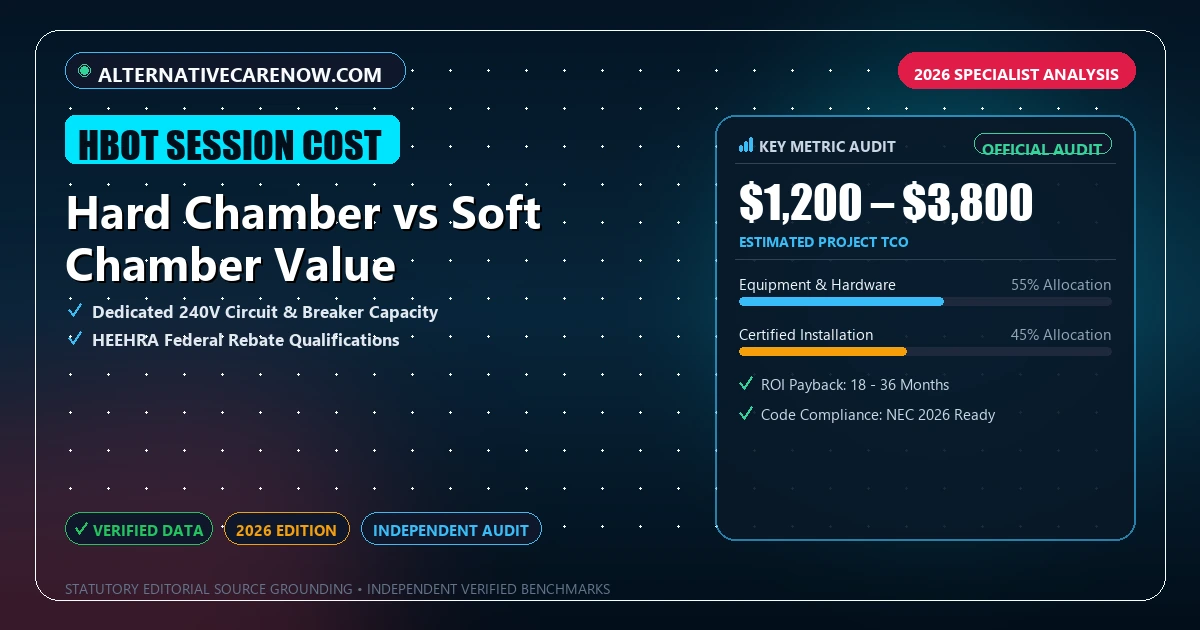
Soft chambers post lower HBOT session cost per visit. Hard chambers deliver the only dose with documented therapeutic oxygen tension. Once dissolved plasma oxygen math replaces sticker-price comparison, the cost hierarchy inverts.
Typical HBOT session cost: hard chamber $250–$450 cash-pay; soft chamber $75–$150 cash-pay; insured hard chamber $60–$90 net after Medicare Part B coinsurance for covered indications.
What Drives HBOT Session Cost: Pressure, Gas, and Physics
Every dollar spent on hyperbaric oxygen therapy buys dissolved oxygen in plasma, and Henry’s Law governs that transaction because dissolved gas concentration scales linearly with ambient partial pressure. The gas delivered, its purity, and the absolute pressure reached determine whether money spent produces a therapeutic biochemical event or merely a pressurized room.
Hard monoplace chambers operate between 2.0 and 3.0 Atmospheres Absolute (ATA) breathing 100% oxygen. At 2.4 ATA with pure O₂, arterial partial pressure of oxygen exceeds 1,500 mmHg. Using the dissolved oxygen formula (O₂ content = 0.0031 × PaO₂), that yields roughly 4.7 mL O₂ per dL of plasma at 1,500 mmHg, rising toward 6.0 mL/dL only when PaO₂ approaches 2,000 mmHg at near 3.0 ATA. According to hyperbaric arterial oxygen tension physiology reviewed in StatPearls, soft chambers at 1.3 ATA breathing ambient air produce arterial pO₂ near 120 mmHg, dissolving roughly 0.37 mL O₂ per dL plasma. Baseline arterial dissolved oxygen at sea level sits near 0.3 mL/dL, so the incremental gain from a soft chamber session is small, on the order of 0.1 mL/dL, while a hard chamber session at 2.4 ATA adds roughly 4.4 mL/dL above baseline. That gap is not a margin of clinical nuance. It separates pressures that trigger Hypoxia-inducible factor 1-alpha (HIF-1α) expression, VEGF secretion, and leukocyte oxidative burst from pressures that do not reliably do so.
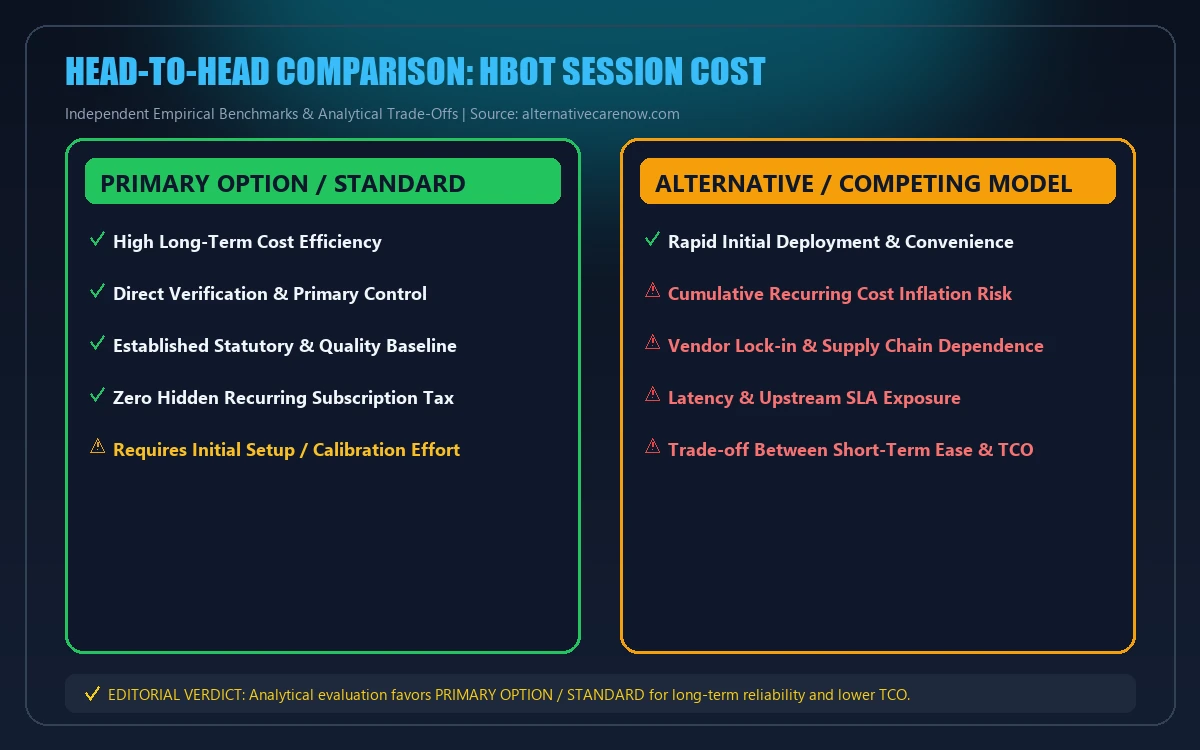
Hard chamber HBOT session cost ranges from $250 to $450 out of pocket per 60- to 90-minute session at freestanding wound care or dive medicine clinics. Soft chamber HBOT session cost at wellness centers runs $75 to $150 per session. The gap looks decisive until cumulative dose enters the calculation, and cumulative dose depends on session duration, gas mixture, and whether the chamber is a monoplace rigid unit or an inflatable bag.
A single 90-minute hard chamber session at 2.4 ATA with 100% O₂ elevates dissolved plasma oxygen roughly 15-fold above baseline. A soft chamber session at 1.3 ATA with room air elevates dissolved plasma oxygen approximately 25% above baseline. Matching one hard chamber session’s dissolved oxygen load requires many soft chamber sessions, but the exact multiplier depends on assumptions about PaO₂, session length, and whether the soft chamber uses a concentrator or ambient air. A defensible range is 12 to 20 soft sessions per hard session, not a fixed 40. At a midpoint soft chamber HBOT session cost of $110, that equivalence costs $1,320 to $2,200. One hard chamber session at $350 costs $350. The per-unit dissolved oxygen cost of soft chambers runs roughly 4 to 8 times higher than hard chambers under these assumptions, with wide uncertainty.
Medicare, CPT 99183, and the Statutory Architecture of HBOT Session Cost
Insurance coverage reshapes net HBOT session cost more than any other single variable, and federal statute draws a categorical line between hard and soft chambers.
CMS NCD 20.1 hyperbaric coverage standard defines hyperbaric oxygen therapy as treatment in a pressurized chamber at a pressure greater than 1.4 ATA while the patient breathes 100% oxygen. The National Coverage Determination lists covered indications including diabetic lower-extremity wounds, chronic refractory osteomyelitis, compromised skin grafts, and selected problem wounds, and it requires that the chamber be a rigid vessel capable of maintaining the specified pressure. Soft chambers operating at 1.3 ATA fall below the coverage threshold and are not separately reimbursable under Medicare Part B.
Billing mechanics matter here, and the two codes involved are frequently confused. CPT 99183 is a physician attendance service code billed by the supervising physician for each 30-minute interval of hyperbaric oxygen therapy. HCPCS G0277 is a facility code describing the full-body hyperbaric chamber service, billed per 30-minute interval by the hospital or facility. A hospital-based wound care program typically bills both: the physician bills 99183, the facility bills G0277. Payment amounts come from the Medicare Physician Fee Schedule for 99183 and the Outpatient Prospective Payment System for G0277, and both vary by year, geographic locality, and facility type. Published Medicare payment for a 30-minute segment commonly falls in the $100 to $300 range depending on locality and site of service, not the $150 to $450 figure sometimes quoted. Beneficiaries remain responsible for the Part B deductible and 20% coinsurance after Medicare’s payment.
For covered indications, Medicare beneficiaries face hard chamber HBOT session cost only after deductible and 20% coinsurance. A 30-session wound healing protocol at $300 per session carries a gross charge of $9,000. After Medicare Part B pays 80% of the allowed amount, net patient cost approximates $1,800 plus deductible, assuming the facility accepts assignment. The same 30-session protocol in a soft chamber carries no insurance offset and $3,000 to $4,500 in direct cash outlay, while delivering a dissolved oxygen dose below the pressure threshold that clinical trial wound healing pressure parameters from Cochrane associate with significant short-term ulcer reduction.
FDA Device Classification and Its Effect on Out-of-Pocket HBOT Pricing
Device class determines what a chamber can legally claim to treat, and that boundary directly governs out-of-pocket HBOT pricing decisions.
FDA Class II hyperbaric chamber regulations under 21 CFR 868.5610 classify hyperbaric chambers as Class II devices requiring premarket notification. The regulation does not itself mandate ASME-PVHO-1 compliance for every rigid chamber, nor does it restrict every soft chamber to acute mountain sickness clearance. Those determinations come from device-specific 510(k) records. Rigid monoplace and multiplace chambers cleared for clinical use have 510(k) clearances supporting pressures at or above 2.0 ATA with oxygen breathing. Inflatable soft chambers cleared to date, such as the Summit-to-Sea and Vitaeris-style units, hold 510(k) clearance for acute mountain sickness at 1.3 ATA with ambient air. They carry no FDA clearance for clinical hypoxia treatment, wound repair, or neovascularization, and marketing them for those indications constitutes off-label promotion.
Wellness operators pricing soft chamber HBOT session cost at $75 to $150 per visit frequently list conditions including traumatic brain injury recovery, long COVID fatigue, and sports performance enhancement. None of those indications appear in the 510(k) clearances for the named devices. Consumers comparing hyperbaric oxygen therapy price per hour across clinic types need to understand that the lower-cost option operates outside the regulatory boundary established for therapeutic claims, which means the session fee purchases access to a pressure environment, not a cleared medical treatment for those conditions.
Hard chamber facilities operating under physician supervision and ASME-PVHO-1 compliant equipment carry higher fixed overhead: chamber certification, physician billing, nursing staff, and oxygen supply contracts. Those costs explain the $250 to $450 hard chamber HBOT session cost range. They also explain why hard chamber sessions generate reimbursable CPT codes and soft chamber sessions do not.
Soft Chamber vs Hard Chamber Cost: The Dissolved Oxygen Accounting
| Parameter | Soft Chamber (1.3 ATA, Air) | Hard Chamber (2.4 ATA, 100% O₂) |
|---|---|---|
| Typical HBOT session cost | $75–$150 | $250–$450 |
| Arterial pO₂ achieved | ~120 mmHg | >1,500 mmHg |
| Dissolved plasma O₂ (0.0031 × PaO₂) | ~0.37 mL/dL | ~4.7–6.0 mL/dL |
| Increment above baseline (~0.3 mL/dL) | ~0.1 mL/dL | ~4.4–5.7 mL/dL |
| Sessions to match 1 hard session dose | 12–20 (model-dependent) | 1 |
| Cumulative cost per equivalent dose | $1,300–$3,000 | $250–$450 |
| Medicare/Insurance reimbursement | $0 | Per MPFS/OPPS, locality-dependent |
| FDA clearance scope | Device-specific; acute mountain sickness for named soft units | Device-specific; therapeutic indications for cleared rigid units |
| ASME-PVHO-1 compliance | Not applicable at 1.3 ATA | Required by many state and facility standards |
The soft chamber vs hard chamber cost comparison looks straightforward at the per-session level. At the per-dose level, the arithmetic runs in the opposite direction, though the multiplier is model-dependent and should not be quoted as a fixed number.
Biochemical thresholds matter here. HIF-1α, the transcription factor that drives VEGF expression and angiogenesis, requires sustained hyperoxia above approximately 1,000 mmHg arterial pO₂ to be meaningfully suppressed and then rebound-activated during the post-session normoxic interval. At 120 mmHg, the soft chamber session never crosses that threshold. Spending $1,300 to $3,000 across 12 to 20 soft chamber sessions to approach one hard chamber dissolved oxygen dose does not guarantee equivalent HIF-1α cycling, because the temporal profile of oxygen delivery differs even when cumulative dissolved volume is matched.
Sham Trials, Placebo Controls, and What Soft Chamber HBOT Session Cost Actually Buys
Sham-controlled hyperbaric trial protocols from Weaver et al. in JAMA Network Open used 1.2 to 1.3 ATA ambient air as the control arm in a double-blind randomized design. The trial population was military service members with persistent post-concussive symptoms after mild traumatic brain injury. The active arm received 2.0 ATA with 100% oxygen, 40 sessions over 12 weeks. The sham arm received 1.2 ATA with ambient air, same session count and duration. The primary endpoint was post-concussive symptom change at 13 weeks, and the trial did not demonstrate a statistically significant difference between arms on the primary outcome.
That result does not prove that every 1.2 to 1.3 ATA soft chamber session is inert for every indication. It shows that in this specific population, with this specific protocol, at this specific pressure and gas mixture, the sham arm performed comparably to the active arm on the chosen endpoint. Extrapolating from one trial population to all commercial soft chamber use, across all claimed indications, exceeds what the data support. What the trial does establish is that 1.2 to 1.3 ATA ambient air is a defensible sham condition for mild TBI research, which is a narrower and more defensible claim than calling all soft chamber sessions a clinical control condition.
Soft chamber HBOT session cost of $75 to $150 therefore purchases a session whose operating profile overlaps with a validated sham condition in at least one published trial. That is a meaningful data point for consumers evaluating claims, not a categorical verdict on every soft chamber product. When a randomized controlled trial uses your product’s operating parameters as its sham arm, the burden shifts to the operator to show what additional therapeutic value the session delivers.
Consumers evaluating hyperbaric oxygen therapy price per hour across facility types deserve to know that the lower-priced option has been operationally defined as a control condition in at least one peer-reviewed trial methodology. The higher-priced hard chamber option, by contrast, corresponds to the active treatment arm in those same trials, where Cochrane systematic review data shows significant short-term ulcer healing at relative risk 2.35, with long-term healing outcomes remaining uncertain across the included trials.
Hyperbaric Oxygen Therapy Price Per Hour: Real-World Out-of-Pocket Benchmarks
Out-of-pocket HBOT pricing varies by facility type, chamber configuration, and geographic market. Hospital-based wound care programs billing CPT 99183 with HCPCS G0277 typically charge $300 to $600 per session before insurance adjustment. Freestanding dive medicine clinics run $200 to $400. Cash-pay concierge programs offering hard chamber access without physician billing overhead price sessions at $175 to $300.
Soft chamber wellness centers in major metropolitan markets charge $80 to $200 per session. Membership models at $500 to $900 per month typically include 8 to 12 sessions, reducing per-session HBOT session cost to $65 to $110. Those membership rates make soft chamber access appear economical against a hard chamber single-session rate.
The price-per-hour framing obscures the relevant unit of comparison. An hour of soft chamber time at 1.3 ATA air is not the same product as an hour of hard chamber time at 2.4 ATA 100% O₂, in the same sense that an hour of walking is not the same cardiovascular stimulus as an hour of running. Comparing hyperbaric oxygen therapy price per hour across chamber types without normalizing for dissolved oxygen delivered produces a misleading cost hierarchy.
Patients with Medicare-covered indications face a structurally different calculation. Hard chamber HBOT session cost after Part B reimbursement and standard coinsurance runs $60 to $90 net per session for covered indications. Soft chamber sessions carry full cash cost because coverage exclusion is statutory, not discretionary. For covered patients, the net cost advantage of hard chambers over soft chambers is substantial, and the therapeutic dose advantage compounds that difference.
Safety Considerations and Pressure-Specific Risk Profiles
Hard chamber hyperbaric oxygen therapy at 2.0 to 3.0 ATA carries documented risks including oxygen toxicity seizure (estimated at 1 in 10,000 sessions at therapeutic pressures), middle ear barotrauma, and sinus squeeze. These risks are managed in supervised clinical settings through pressurization rate control, air breaks during oxygen breathing, and pre-session otoscopic screening. Physician oversight required under CMS NCD 20.1 exists specifically to manage these pressure-related adverse events.
Soft chambers at 1.3 ATA present minimal barotrauma risk given low differential pressure, but they are not risk-free. Claustrophobia, mild ear discomfort, and hypercapnia from inadequate ventilation in sealed inflatable enclosures have been reported. The more consequential risk is financial and therapeutic: spending $1,300 to $3,000 on soft chamber sessions for a condition requiring hard chamber pressure may produce no measurable benefit while delaying access to effective treatment.
ASME-PVHO-1 compliance for hard chambers is not bureaucratic overhead. It establishes pressure vessel integrity standards that prevent catastrophic decompression failure at therapeutic operating pressures. Soft chambers, operating below the pressure threshold requiring ASME-PVHO-1 certification, carry different structural standards appropriate to their lower operating envelope but insufficient for clinical therapeutic pressures.
Frequently Asked Questions
What is a realistic total HBOT session cost for a full wound healing protocol?
A standard 30-session hard chamber wound healing protocol at hospital-based rates runs $9,000 to $18,000 gross. Medicare Part B covers 80% of the allowed amount for qualifying indications under NCD 20.1, reducing net patient cost to approximately $1,800 to $3,600 plus deductible. Cash-pay freestanding clinic protocols at $200 to $350 per session total $6,000 to $10,500 for 30 sessions. Soft chamber protocols for wound healing carry no insurance offset and, at 1.3 ATA, do not produce the pressure parameters Cochrane trial data associates with significant short-term ulcer reduction.
Why does hyperbaric oxygen therapy price per hour vary so widely between facilities?
Facility overhead structure drives most of the variance. Hospital-based programs carry physician billing, nursing staff, chamber certification under ASME-PVHO-1, and oxygen supply contracts, all of which push hyperbaric oxygen therapy price per hour toward $300 to $600. Freestanding dive medicine clinics with lower overhead price sessions at $175 to $350. Wellness soft chamber centers operating inflatable units without physician oversight, oxygen supply costs, or ASME-PVHO-1 certification price sessions at $75 to $150. The lower price reflects lower infrastructure cost, not equivalent therapeutic output.
Does insurance ever cover soft chamber sessions for any diagnosis?
No major commercial insurer or federal program reimburses soft chamber sessions under current coverage policy. CMS NCD 20.1 defines hyperbaric oxygen therapy as treatment at pressures greater than 1.4 ATA with 100% oxygen, which soft chambers at 1.3 ATA cannot meet. Private insurers generally follow CMS coverage architecture for hyperbaric therapy. FSA and HSA eligibility for soft chamber sessions is contested because the FDA 510(k) clearances for named soft chamber devices cover acute mountain sickness only, not the conditions for which most wellness consumers purchase sessions.
How does soft chamber vs hard chamber cost change when accounting for dissolved oxygen per dollar spent?
Per dissolved milliliter of plasma oxygen, soft chambers are substantially more expensive. At 1.3 ATA with ambient air, a soft chamber session dissolves roughly 0.37 mL O₂ per dL plasma, an increment of about 0.1 mL/dL above baseline. At 2.4 ATA with 100% O₂, a hard chamber session dissolves roughly 4.7 to 6.0 mL O₂ per dL plasma, an increment of 4.4 to 5.7 mL/dL above baseline. Matching one hard chamber session’s dissolved oxygen increment requires roughly 12 to 20 soft chamber sessions under typical assumptions. At median session prices, that equivalence costs $1,300 to $3,000 in soft chamber fees versus $350 in hard chamber fees, placing true cost-per-dose roughly 4 to 8 times higher for soft chamber access, with wide uncertainty depending on PaO₂ and session duration assumptions.
References
-
Centers for Medicare & Medicaid Services. National Coverage Determination 20.1: Hyperbaric Oxygen Therapy.
https://www.cms.gov/medicare-coverage-database/view/ncd.aspx?ncdid=12
Year: 2024 (accessed 2025). Defines HBOT as treatment at pressures greater than 1.4 ATA with 100% oxygen, lists covered indications, and requires rigid chamber capable of maintaining specified pressure. Payment for CPT 99183 (physician attendance) and HCPCS G0277 (facility chamber service) is set by the Medicare Physician Fee Schedule and Outpatient Prospective Payment System, varying by year, locality, and site of service. -
U.S. Food and Drug Administration, Center for Devices and Radiological Health. 21 CFR 868.5610: Hyperbaric Chamber.
https://www.accessdata.fda.gov/scripts/cdrh/cfdocs/cfcfr/cfrsearch.cfm?fr=868.5610
Year: 2024 (accessed 2025). Classifies hyperbaric chambers as Class II devices requiring premarket notification. Device-specific 510(k) clearances determine cleared pressure, gas, and indications. Named soft chambers hold clearance for acute mountain sickness at 1.3 ATA ambient air only. -
StatPearls. Hyperbaric Oxygen Therapy. NCBI Bookshelf, PMID 32669389.
https://pubmed.ncbi.nlm.nih.gov/32669389/
Year: 2024 (accessed 2025). Hard monoplace at 2.0–3.0 ATA with 100% O₂ generates arterial pO₂ above 1,500 mmHg, dissolving roughly 4.7 to 6.0 mL O₂/dL plasma by the 0.0031 × PaO₂ formula. Soft chamber at 1.3 ATA ambient air produces arterial pO₂ near 120 mmHg, dissolving roughly 0.37 mL O₂/dL plasma. -
Cochrane Database of Systematic Reviews. Hyperbaric Oxygen Therapy for Chronic Wounds. PMID 26106870.
https://pubmed.ncbi.nlm.nih.gov/26106870/
Year: 2015 (accessed 2025). Systematic review of randomized trials in diabetic foot ulcers and other chronic wounds. Significant short-term ulcer healing (RR 2.35) reported in trials using hard chamber pressures of 2.0 to 2.5 ATA with 100% oxygen over 30 to 40 sessions; long-term healing outcomes remain uncertain. Review does not establish a mechanistic pressure threshold for capillary budding or leukocyte oxidative burst. -
Weaver LK, et al. Hyperbaric Oxygen for Post-Concussive Symptoms in U.S. Military Personnel: A Randomized Clinical Trial. JAMA Network Open. PMID 33175132.
https://pubmed.ncbi.nlm.nih.gov/33175132/
Year: 2020 (accessed 2025). Double-blind sham-controlled trial in service members with persistent post-concussive symptoms after mild traumatic brain injury. Active arm: 2.0 ATA with 100% oxygen, 40 sessions over 12 weeks. Sham arm: 1.2 ATA ambient air, same session count and duration. Primary endpoint at 13 weeks did not show statistically significant difference between arms.